
ISO 17020 Certification – Accreditation for Inspection Bodies
To get ISO 17020 certification, more accurately known as ISO/IEC 17020 accreditation, inspection bodies must follow a structured process that includes gap analysis, establishing impartiality and independence, ensuring inspector competence, documenting inspection methods, implementing a management system, internal audits, management review, and an assessment by a national accreditation body. Demonstrating impartial, consistent, and technically competent inspections is essential at every stage. With TopCertifier's guidance, inspection bodies can align with the new ISO/IEC 17020:2026 edition, avoid common assessment findings, strengthen client trust, and achieve accreditation with confidence. For more information, contact us at info@topcertifier.com.
Get Free Consultation Call Us Now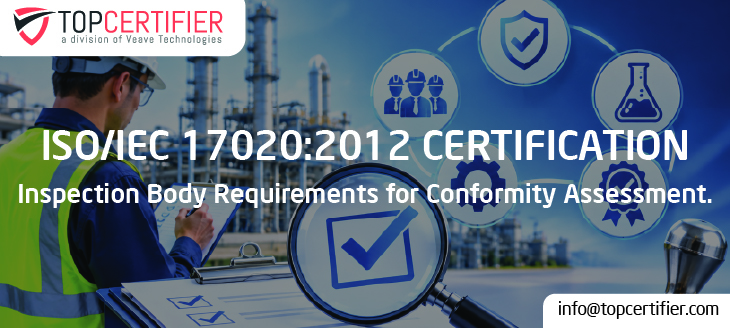
What is ISO 17020 Certification?
ISO 17020 Certification refers to accreditation of an inspection body against ISO/IEC 17020, the international standard titled “Conformity assessment – Requirements for bodies performing inspection.” The standard is developed by the International Organization for Standardization (ISO) and the International Electrotechnical Commission (IEC).
ISO/IEC 17020:2026 covers the activities of inspection bodies whose work can include the examination of materials, products, installations, plants, processes, work procedures or services. Accreditation demonstrates that an inspection body is impartial, independent to the required degree, technically competent, and able to deliver consistent and reliable inspection results.
ISO 17020 Certification vs ISO 17020 Accreditation
Although “ISO 17020 certification” is a commonly used term, inspection bodies are formally accredited, not certified, to ISO/IEC 17020. The difference matters:
Certification
is issued by certification bodies and confirms that a management system, such as ISO 9001, meets a standard.
Accreditation
is granted by a national accreditation body and confirms technical competence to perform specific conformity assessment activities, such as inspection.
ISO/IEC 17020 accreditation is granted by national accreditation bodies, such as NABCB in India, and covers a defined scope of inspection activities. Accredited inspection bodies can issue inspection reports and certificates that carry the credibility of accreditation.
What’s New in ISO/IEC 17020:2026?
The new edition brings important changes for inspection bodies seeking ISO 17020 Certification:
Major Revision:
The third edition is described as the most significant revision in over a decade, with a focus on clarity, structure, and application of requirements.
New Independence Categories:
Inspection bodies are now classified into two categories regarding impartiality, type A and non-type A (previously types A, B, and C).
New Definitions:
Definitions have been added for “item” (the object being inspected) and “client” (the party requesting the inspection).
Data and Risk Management:
A new subclause on the control of data and information and actions to address risks and opportunities has been added.
Risk-Based Approach:
Risk-based thinking has enabled some reduction in prescriptive requirements and their replacement by performance-based requirements.
Greater Flexibility:
There is greater flexibility than in the previous edition in the requirements for processes, procedures, documented information and organizational responsibilities.
Alignment with Other Standards:
New common elements are being introduced to align ISO/IEC 17020 with other conformity assessment standards such as ISO/IEC 17025 and ISO/IEC 17065.
Inspection bodies already accredited to the 2012 edition will need to transition to the new requirements, and new applicants should prepare against ISO/IEC 17020:2026.
Why is ISO 17020 Certification Important?
Inspection results influence critical decisions about safety, quality, compliance, and acceptance of products, installations, and services. Regulators, manufacturers, project owners, insurers, and buyers need confidence that inspection findings are accurate, impartial, and based on competent judgment.
ISO 17020 Certification provides that confidence. It demonstrates that an inspection body operates independently of commercial pressures, uses competent inspectors, follows defined inspection methods, and maintains a reliable management system. Many government agencies, regulatory schemes, and large clients require or prefer accredited inspection bodies, making accreditation a key business enabler.
Types of Inspection Bodies Under ISO/IEC 17020:2026
Independence is a central concept in ISO 17020 Certification. Under the 2026 edition, inspection bodies fall into two categories:
Type A Inspection Body:
An inspection body that is fully independent of the parties involved with the items it inspects, providing third-party inspection services.
Non-Type A Inspection Body:
An inspection body that does not meet Type A independence criteria, such as inspection functions that are part of, or linked to, an organization involved in the design, manufacture, supply, or use of the items inspected. These bodies must still demonstrate impartiality and appropriate safeguards.
This replaces the previous three-category model of Types A, B, and C used in the 2012 edition. Inspection bodies should review their independence status against the new criteria.
Key Requirements of ISO 17020 Certification
ISO/IEC 17020 covers requirements across several areas:
General Requirements
Impartiality and independence, including identification and management of risks to impartiality.
Confidentiality of information obtained during inspection activities.
Legal responsibility and liability arrangements.
Structural Requirements
Defined organizational structure and responsibilities.
Technical management responsible for inspection activities.
Clear documentation of the inspection body’s scope of activities.
Resource Requirements
Competent inspection personnel with appropriate qualifications, training, and experience.
Supervision and monitoring of inspector performance.
Suitable facilities and equipment, including calibration where relevant.
Control of subcontracted inspection activities.
Process Requirements
Inspection methods and procedures that are suitable and documented.
Handling of inspection items and samples.
Inspection records and traceability.
Inspection records and traceability
Inspection reports and certificates with required content
Handling of complaints and appeals
Control of data and information
Management System Requirements
Document and record control.
Confidentiality of information obtained during inspection activitiesActions to address risks and opportunities.
Internal audits.
Inspection records and traceability.
Management review.
Corrective actions and continual improvement.
Achieve ISO 17020 Certification: A Strategic 10-Step Approach
With this structured 10-step approach, inspection bodies seeking ISO 17020 Certification can achieve accreditation efficiently while strengthening the credibility of their inspection services.
Benefits of ISO 17020 Certification
Why Choose TopCertifier for ISO 17020 Certification?
TopCertifier is a leading ISO consulting and certification service provider that helps inspection bodies achieve ISO/IEC 17020 accreditation efficiently and effectively. Our team of experienced ISO 17020 Consultants provides end-to-end support, including gap analysis, impartiality and risk assessment, documentation, inspector competence frameworks, management system implementation, internal audits, and accreditation assessment preparation.
With strong expertise across inspection sectors and a global presence, TopCertifier delivers customized solutions tailored to your inspection scope, independence type, and accreditation body requirements. We help inspection bodies align with the new ISO/IEC 17020:2026 edition and transition smoothly from the 2012 edition. Our proven methodology helps organizations strengthen credibility, satisfy regulators and clients, and achieve successful ISO 17020 Certification.
ISO Certifications
- ISO 27018 Certification - Quality Management System (QMS)
- ISO 14001 Certification - Environmental Management System (EMS)
- ISO 45001 Certification - Occupational Health and Safety Management System (OHSMS)
- ISO 22000 Certification - Food Safety Management System (FSMS)
- ISO 27001 Certification - Information Security Management System (ISMS)
- CMMI Certification - Capability Maturity Model Integration
- EU GDPR Certification - European Union General Data Protection Regulation
- HIPAA Certification - Health Insurance Portability and Accountability Act
- PCI DSS Certification - Payment Card Industry Data Security Standard
- SOC 2 Certification - Service Organization Control 2
- CE Mark Certification - Conformité Européenne
- ISO 20000 Certification - IT Service Management System (ITSMS)
- ISO 42000 Certification - Artificial Intelligence Management System (AIMS)
- TISAX Certification - Trusted Information Security Assessment Exchange
- GMP Certification - Good Manufacturing Practices
Our Security Services
- TPRM Service
- SIEM Service
- SOC and NOC Service
- SOC as a Service
- NOC as a Service
- SSAE 18 and SSAE 16 Report
- ISAE 3402 and ISAE 3000 Report
- SSAE 3402 and SSAE 3000 Report
- SOX Attestation
- US GAAP Audit and Reporting
- CPA Firm
- Smeta Audit Service
Frequently Asked Questions
ISO 17020 Certification refers to accreditation of an inspection body against ISO/IEC 17020, demonstrating impartiality, independence, and technical competence in performing inspections.
Inspection bodies are formally accredited, not certified, to ISO/IEC 17020. Accreditation is granted by national accreditation bodies, such as NABCB in India.
The latest version is ISO/IEC 17020:2026, which replaced the 2012 edition.
Type A inspection bodies are fully independent third parties. Non-Type A bodies have some link to the items inspected but must still demonstrate impartiality. This replaces the earlier Types A, B, and C.
Organizations providing inspection services, such as engineering, pressure equipment, pre-shipment, electrical, fire safety, vehicle, marine, and commodity inspection bodies, benefit from accreditation.
ISO 17020 applies to inspection bodies and focuses on inspection and professional judgment, while ISO 17025 applies to testing and calibration laboratories.
Assessors review impartiality, inspector competence, inspection methods, records, reports, equipment, complaints handling, and the management system, and often witness inspections on site.
TopCertifier provides end-to-end support, including gap analysis, impartiality assessment, documentation, competence frameworks, implementation, internal audits, and accreditation assessment preparation.
Client Review





GLOBAL SUPPORT
India| USA| Canada| London| UK| Australia| New Zealand| South Africa| Singapore| Dubai,Uae| Saudi Arabia| SriLanka| Bangladesh| Myanmar| Germany| Malaysia| Fiji| Maldives| Bahrain| Kuwait| Oman| Qatar| Nigeria| Kenya| Lebanon| Iraq| Jordan| Thailand| Philippines| Spain| Turkey| Israel| Iran| Algeria| Angola| Ethiopia| Congo| Belgium| Austria| Portugal| Italy
Our Recent Blogs