
PCI DSS Compliance: Merchant Levels, Validation and Staying Compliant All Year
PCI DSS compliance means meeting every applicable requirement of the Payment Card Industry Data Security Standard, currently version 4.0.1, and proving it each year to your acquiring bank or clients. This page explains who must comply, how merchant and service provider levels decide your validation, what has to happen daily, quarterly and annually to stay compliant, and how TopCertifier helps you run a compliance programme that holds up between assessments. For more information, contact us at info@topcertifier.com.
Get Free Consultation Call Us Now
PCI DSS is a contractual obligation, not a law. Card brands such as Visa and Mastercard require it, and your acquiring bank or payment processor enforces it through your merchant agreement. Service providers usually face the same requirement from their clients. Because version 4.0 placed more emphasis on controls operating continuously, compliance is now about running security processes all year, not preparing evidence the month before an assessment.
No such thing as an official "PCI certificate": the PCI Security Standards Council publishes the standard but does not certify merchants or service providers. What you receive after validation is an Attestation of Compliance (AOC), backed by either a Report on Compliance from a QSA or a Self-Assessment Questionnaire.
Who Must Be PCI DSS Compliant?
- Merchants: any business that accepts card payments, online, in store or by phone, whatever its size
- Service providers: companies that store, process or transmit card data for others, or can affect its security, such as payment gateways, processors, hosting and cloud providers, managed security providers and call centres
Using a PCI DSS compliant payment provider reduces your scope, but it does not remove your own obligation. You still need to validate the requirements that apply to how you accept cards.
Merchant Levels and Validation Requirements
Card brands group merchants by annual transaction volume. The commonly used Visa definitions are shown below; your acquirer confirms your level and may set stricter requirements.
| Level | Annual card transactions | Typical validation |
|---|---|---|
| Level 1 | More than 6 million | Annual Report on Compliance by a QSA (or ISA), quarterly ASV scans, AOC |
| Level 2 | 1 to 6 million | Annual SAQ (some acquirers require a QSA or ISA), quarterly ASV scans, AOC |
| Level 3 | 20,000 to 1 million e-commerce | Annual SAQ, quarterly ASV scans where applicable, AOC |
| Level 4 | Fewer than 20,000 e-commerce, or up to 1 million total | Annual SAQ and ASV scans where applicable, as required by the acquirer |
Service providers are usually split into two levels: Level 1, processing more than 300,000 transactions a year, which requires a QSA Report on Compliance, and Level 2, which can usually validate with SAQ D for service providers.
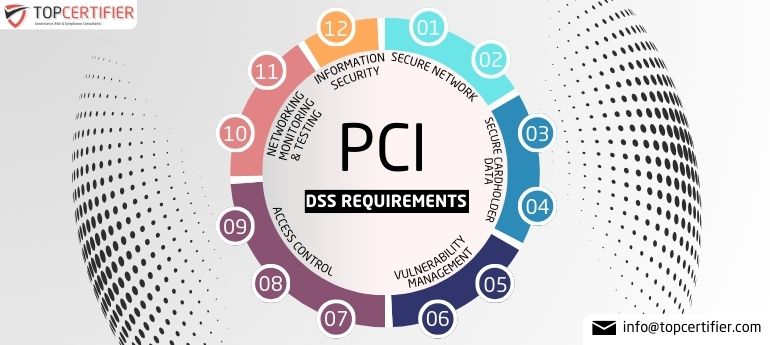
The 12 PCI DSS Requirements at a Glance
| Goal | Requirements |
|---|---|
| Build and maintain a secure network | 1. Network security controls | 2. Secure configurations |
| Protect account data | 3. Protect stored account data | 4. Strong cryptography in transmission |
| Vulnerability management | 5. Anti-malware | 6. Secure systems and software |
| Strong access control | 7. Restrict access by need to know | 8. Identify users and authenticate access | 9. Restrict physical access |
| Monitor and test networks | 10. Log and monitor access | 11. Test security regularly |
| Information security policy | 12. Policies and programmes that support security |
For a detailed explanation of each requirement, see our guide to PCI DSS requirements.
Staying PCI DSS Compliant: A Year-Round Calendar
| Frequency | Typical activities |
|---|---|
| Daily / continuous | Security log review (usually automated), anti-malware updates, monitoring of payment page scripts, response to alerts |
| Quarterly | External ASV scans with passing results, internal vulnerability scans, rescans after remediation |
| Every six months | For service providers: segmentation testing and confirmation of PCI DSS scope; review of firewall and router rule sets where required |
| Annually | Penetration testing, scope confirmation, targeted risk analyses, policy and incident response plan review and testing, security awareness training, third-party service provider compliance checks, formal validation (ROC or SAQ) and AOC |
| After any significant change | Re-scans, re-testing and scope updates when systems, networks or payment flows change |
Assessors now expect evidence that these activities happened throughout the year. Missing quarters of scans or logs are one of the most common reasons organisations fail validation.
What Happens If You Are Not Compliant?
Consequences come through your contracts rather than a regulator. They can include monthly non-compliance fees from your acquirer, higher transaction charges, responsibility for card brand fines and fraud losses after a breach, the cost of a mandatory PCI Forensic Investigator (PFI) investigation, and in serious cases losing the ability to accept card payments. Service providers can lose clients who require a current AOC.
How TopCertifier Supports Ongoing PCI DSS Compliance
1. Compliance Programme Setup
We define your scope, assign control owners and set up a compliance calendar with clear evidence requirements.
2. Policies and Procedures
We write the policies, procedures and targeted risk analyses that PCI DSS v4.0.1 requires, matched to how you operate.
3. Recurring Activity Tracking
We track scans, reviews, training and testing each quarter, and follow up on anything overdue.
4. Third-Party Management
We maintain your list of service providers, their responsibilities and current compliance evidence.
5. Annual Validation Support
We prepare you for your yearly ROC or SAQ. For a full pre-assessment, see our PCI DSS audit services.
Planning Your First Validation?
If you are new to PCI DSS, start with our overview of PCI DSS certification and our step-by-step guide on how to get PCI DSS certification. Our page on PCI DSS certification cost explains what drives the budget, and our guide to the PCI DSS audit describes what happens during the formal assessment.
PCI DSS Compliance Success Stories
- E-Commerce Merchant Reduced Scope: An online retailer moved to a hosted payment page, cutting its scope from SAQ D to a much shorter SAQ and simplifying ongoing compliance.
- Payment Service Provider Kept Its AOC Current: A service provider used our compliance calendar to keep quarterly scans, six-monthly segmentation tests and evidence on track between its annual QSA assessments.
- BPO Secured Card Payments Over the Phone: A call centre removed card numbers from call recordings and desktops, reducing the systems in scope and the risk of a breach.
Why Choose TopCertifier for PCI DSS Compliance?
PCI DSS Compliance Experts
Download PCI DSS BrochureTopCertifier, a division of Veave Technologies Pvt. Ltd., helps merchants and service providers build PCI DSS compliance into everyday operations. We start by reducing scope, then put in place the processes, evidence and ownership that keep you compliant all year.
We are an advisory firm and work alongside your QSA or acquirer. We do not issue certificates or Attestations of Compliance, so our advice stays focused on what genuinely reduces your risk and effort.
PCI DSS Templates Free Download
Our Security Services
- TPRM Service
- SIEM Service
- SOC and NOC Service
- SOC as a Service
- NOC as a Service
- SSAE 18 and SSAE 16 Report
- ISAE 3402 and ISAE 3000 Report
- SSAE 3402 and SSAE 3000 Report
- SOX Attestation
- US GAAP Audit and Reporting
- CPA Firm
- Smeta Audit Service
ISO Certifications
- ISO 9001 Certification - Quality Management System
- ISO 14001 Certification - Environmental Management
- ISO 45001 Certification
- ISO 22000 Certification - Food Safety Management System
- ISO 27001 Certification - Information Security Management
- CMMI Certification - Capability Maturity Model Integration
- EU GDPR Certification - General Data Protection Regulation
- HIPAA Certification – Health Insurance Portability and Accountability Act
- PCI DSS Certification - Payment Card Industry
- SOC 2 Certification - System Organisation Standard
What Will Certification Cost?
Certification cost depends on:
- ✓Company size – total number of employees, including contract staff
- ✓ISO standard chosen – ISO 9001, ISO 14001, ISO 45001 or ISO 27001
- ✓Nature of your business – the products or services covered in your certification scope
Frequently Asked Questions
PCI DSS compliance means meeting all applicable requirements of the Payment Card Industry Data Security Standard, currently version 4.0.1, and validating it each year through a Report on Compliance or Self-Assessment Questionnaire with an Attestation of Compliance.
It is not a law, but it is a contractual requirement for any business that accepts card payments or handles card data on behalf of others. Card brands require it and acquiring banks enforce it through merchant agreements.
No. The PCI Security Standards Council does not certify merchants or service providers. Organisations demonstrate compliance with an Attestation of Compliance, supported by a QSA Report on Compliance or a Self-Assessment Questionnaire.
Your level is based on annual card transaction volume per card brand, and your acquiring bank confirms it. Under the common Visa definitions, Level 1 is more than 6 million transactions a year and Level 4 is fewer than 20,000 e-commerce transactions or up to 1 million in total.
Yes, although a compliant gateway or hosted payment page can greatly reduce your scope. You still need to complete the validation that applies to how you accept cards, often a shorter SAQ.
At minimum, run external vulnerability scans by an Approved Scanning Vendor and internal vulnerability scans, fix any failures and rescan until results pass. Keep the reports as evidence for your annual validation.
Version 4.0.1 is a clarified version of 4.0 and is now the only active version. The requirements that were future-dated in 4.0, such as wider multi-factor authentication, payment page script controls and targeted risk analyses, became mandatory on 31 March 2025.
Penalties are contractual and can include monthly non-compliance fees from the acquirer, higher transaction fees, liability for card brand fines and fraud losses after a breach, forensic investigation costs and, in serious cases, losing the ability to accept cards.
Annually, with quarterly ASV scans in between. Many activities, such as log reviews, scans, training and testing, must also happen on their own schedules throughout the year.
We set up your compliance programme and calendar, write policies and targeted risk analyses, track recurring activities and third parties, and prepare you for your annual QSA assessment or SAQ. We do not issue AOCs or certificates.
Client Review






GLOBAL SUPPORT
India| USA| Canada| London| UK| Australia| New Zealand| South Africa| Singapore| Dubai,Uae| Saudi Arabia| SriLanka| Bangladesh| Myanmar| Germany| Malaysia| Fiji| Maldives| Bahrain| Kuwait| Oman| Qatar| Nigeria| Kenya| Lebanon| Iraq| Jordan| Thailand| Philippines| Spain| Turkey| Israel| Iran| Algeria| Angola| Ethiopia| Congo| Belgium| Austria| Portugal| Italy
Our Recent Blogs