
PCI DSS Certification Cost – Complete Guide to Pricing, Audit Fees & Compliance Costs
Understand PCI DSS Certification Cost and the factors that influence your compliance investment. PCI DSS certification costs vary based on your organization's size, payment environment, compliance level, infrastructure complexity, and assessment requirements. Our experts help businesses optimize certification expenses through PCI DSS gap analysis, implementation support, audit readiness, risk assessment, and compliance consulting, ensuring cost-effective compliance while protecting cardholder data and meeting PCI DSS requirements.
Understanding the PCI DSS Certification Cost is one of the first steps for organizations planning to secure payment card data and achieve compliance with the Payment Card Industry Data Security Standard (PCI DSS). The cost of PCI DSS certification varies depending on several factors, including the size of the organization, annual payment transaction volume, PCI DSS compliance level, IT infrastructure, number of business locations, and the complexity of the cardholder data environment. Investing in PCI DSS compliance helps businesses reduce cybersecurity risks, protect sensitive payment information, and demonstrate their commitment to secure payment processing.
PCI DSS Certification Cost is not fixed and depends on your organization's compliance scope, existing security controls, audit requirements, and implementation complexity. Every business has unique security and compliance needs that influence the overall certification investment.
For many small and medium-sized organizations, the overall PCI DSS certification cost may typically start from approximately ₹80,000 to ₹2,50,000, while larger enterprises with complex payment environments may require a significantly higher investment. The final cost varies based on business requirements, compliance level, remediation efforts, and assessment scope.
What is PCI DSS Certification Cost?
The PCI DSS (Payment Card Industry Data Security Standard) certification cost refers to the overall investment required to achieve and maintain PCI DSS compliance. It typically includes expenses related to PCI DSS gap analysis, security assessments, compliance consulting, implementation support, vulnerability assessments, penetration testing, audit preparation, compliance validation, and continuous monitoring activities.
Since every organization has a different payment infrastructure and compliance scope, there is no standard pricing applicable to all businesses. Organizations processing a higher volume of payment card transactions or operating multiple payment environments generally require more comprehensive assessments and security implementations, which may increase the total certification cost.
Rather than viewing PCI DSS certification as an expense, many organizations consider it a long-term investment that strengthens payment security, minimizes the risk of costly data breaches, enhances customer trust, and supports compliance with global payment industry requirements.
What Does PCI DSS Certification Cost Include?
The total PCI DSS certification cost generally consists of multiple compliance activities rather than a single certification fee. Depending on your organization's current compliance status, the overall investment may include:
- PCI DSS Gap Analysis
- PCI DSS Compliance Consulting
- Security Control Implementation Guidance
- Risk Assessment
- Vulnerability Assessment & Penetration Testing
- Internal Compliance Review
- Audit Preparation & Assessment Support
- Documentation & Policy Development
- Continuous Compliance & Security Monitoring
Why Does PCI DSS Certification Cost Vary?
No two organizations have the same payment environment or cybersecurity maturity level. Therefore, PCI DSS certification pricing varies considerably from one business to another. Factors such as the number of payment transactions processed annually, the PCI DSS compliance level, network complexity, cloud infrastructure, number of business locations, existing security controls, and remediation requirements all influence the total certification cost.
Working with experienced PCI DSS consultants helps organizations optimize implementation efforts, reduce unnecessary compliance expenses, and achieve certification in a cost-effective manner while ensuring full compliance with PCI DSS requirements.
Factors Affecting PCI DSS Certification Cost
The PCI DSS Certification Cost varies for every organization based on its payment environment, security infrastructure, and compliance requirements. Understanding these factors helps businesses estimate their certification investment and plan their PCI DSS compliance journey effectively.
1. PCI DSS Compliance Level
Organizations are classified into different PCI DSS compliance levels based on their annual payment card transactions. Higher compliance levels usually require broader assessments and more extensive validation, increasing the certification cost.
2. Organization Size
The number of employees, business locations, payment systems, and IT assets affects the overall certification effort. Larger organizations generally require more assessment and implementation activities.
3. Cardholder Data Environment (CDE)
The complexity of the Cardholder Data Environment (CDE) significantly influences certification costs. Multiple payment applications, cloud infrastructure, and interconnected networks usually require a wider assessment scope.
4. Existing Security Controls
Organizations with strong existing security controls often require fewer remediation activities, helping reduce implementation effort and overall certification costs.
5. PCI DSS Gap Analysis
A PCI DSS gap analysis identifies missing security controls and compliance gaps. The number of findings directly affects the implementation effort and certification cost.
6. Vulnerability Assessment & Penetration Testing
Vulnerability assessments and penetration testing verify the effectiveness of security controls. The testing scope and network size influence the associated costs.
7. Number of Business Locations
Organizations operating from multiple locations may require additional assessments to verify compliance across all payment environments.
8. Documentation & Policy Development
Preparing PCI DSS policies, procedures, and security documentation is essential. Businesses without existing documentation may require additional consulting support.
9. Audit & Compliance Assessment
The final assessment may include documentation reviews, Self-Assessment Questionnaires (SAQs), QSA validation, and evidence verification based on compliance requirements.
10. Ongoing Compliance & Annual Maintenance
PCI DSS compliance requires ongoing monitoring, vulnerability scans, employee training, and periodic reviews, which should be considered when estimating long-term certification costs.
Industries That Commonly Invest in PCI DSS Certification
- E-Commerce & Online Shopping Platforms
- Banks & Financial Institutions
- FinTech Companies
- Payment Gateways & Payment Service Providers
- Retail Chains & Supermarkets
- Hospitality, Hotels & Travel Companies
- Healthcare Organizations Accepting Online Payments
- SaaS Companies & Cloud Service Providers
- Educational Institutions Processing Online Fees
- Subscription-Based Businesses
Why Choose TopCertifier for PCI DSS Compliance Certification?

PCI DSS Compliance Experts
Download PCI DSS BrochureTopCertifier, a division of Veave Technologies Pvt. Ltd., provides end-to-end PCI DSS Compliance Certification services to organizations across various industries. Our experienced consultants assist businesses with PCI DSS gap analysis, compliance implementation, security assessments, audit preparation, remediation support, and continuous compliance management.
Using industry best practices and proven implementation methodologies, TopCertifier helps organizations achieve PCI DSS Compliance Certification efficiently while strengthening payment security, protecting cardholder data, reducing cyber risks, and maintaining long-term compliance with PCI DSS requirements.
Related PCI DSS Resources
PCI DSS Templates Free Download
Our Security Services
- TPRM Service
- SIEM Service
- SOC and NOC Service
- SOC as a Service
- NOC as a Service
- SSAE 18 and SSAE 16 Report
- ISAE 3402 and ISAE 3000 Report
- SSAE 3402 and SSAE 3000 Report
- SOX Attestation
- US GAAP Audit and Reporting
- CPA Firm
- Smeta Audit Service
ISO Certifications
- ISO 9001 Certification - Quality Management System
- ISO 14001 Certification - Environmental Management
- ISO 45001 Certification
- ISO 22000 Certification - Food Safety Management System
- ISO 27001 Certification - Information Security Management
- CMMI Certification - Capability Maturity Model Integration
- EU GDPR Certification - General Data Protection Regulation
- HIPAA Certification – Health Insurance Portability and Accountability Act
- PCI DSS Certification - Payment Card Industry
- SOC 2 Certification - System Organisation Standard
Frequently Asked Questions
PCI DSS (Payment Card Industry Data Security Standard) Certification is a security compliance framework that helps organizations protect cardholder data, secure payment environments, and implement industry-recognized security controls for handling payment information.
PCI DSS Certification is required for organizations that store, process, or transmit payment card information, including e-commerce businesses, payment service providers, financial institutions, fintech companies, and organizations handling cardholder data.
PCI DSS Compliance helps organizations protect sensitive payment information, reduce security risks, improve customer trust, prevent data breaches, and maintain secure payment processing practices.
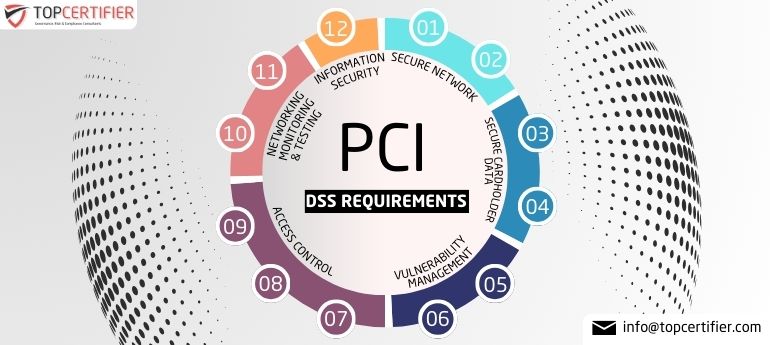
PCI DSS requirements include protecting cardholder data, maintaining secure networks, implementing access controls, managing vulnerabilities, monitoring security activities, and maintaining information security policies to protect payment environments.
The PCI DSS Certification process generally includes scope identification, gap analysis, security assessment, implementation of required controls, vulnerability management, compliance validation, and audit support.
PCI DSS Gap Analysis evaluates an organization's existing security practices against PCI DSS requirements to identify compliance gaps, security weaknesses, and improvement areas before formal assessment.
PCI DSS Certification helps organizations strengthen payment security, protect cardholder information, improve cybersecurity practices, demonstrate compliance commitment, and build confidence among customers and business partners.
Organizations can achieve PCI DSS Certification by understanding applicable requirements, performing a compliance gap analysis, implementing necessary security controls, conducting security reviews, and completing the required compliance validation process.
Client Review






GLOBAL SUPPORT
India| USA| Canada| London| UK| Australia| New Zealand| South Africa| Singapore| Dubai,Uae| Saudi Arabia| SriLanka| Bangladesh| Myanmar| Germany| Malaysia| Fiji| Maldives| Bahrain| Kuwait| Oman| Qatar| Nigeria| Kenya| Lebanon| Iraq| Jordan| Thailand| Philippines| Spain| Turkey| Israel| Iran| Algeria| Angola| Ethiopia| Congo| Belgium| Austria| Portugal| Italy
Our Recent Blogs